I've decided to start posting about some of the coolest critters you'll find in the Oceans, there is a ton of taxonomic and evolution weirdness that is just not talked about nearly enough.
So here is a list of the five coolest Nudibranchs in my opinion. There are definitely more colorful Nudibranchs out there, but in terms of morphological weirdness/interest these are kind of at the top.
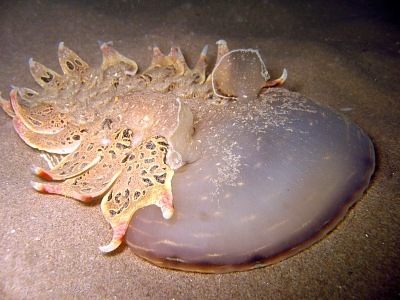
This thing is just weird. It is the only species within this genus, and frankly nothing else looks like it. It is related to the predatory Melibe, itself an interesting animal in that it actively hunts copepods and other tiny shrimp-like crustaceans by enveloping them in their giant oral hood. Like a diabolical fishing net, or an aquatic venus flytrap. Here is a video for you to get an idea of how Melibe hunts.
Creepy. Tethys feeds in the same manner, which would be cool enough by itself. But then you realize how BIG Tethys can get - almost 30 cm. Nudibranchs usually don't get much bigger than 10cm, and the colorful ones are tiny. 30 cm is massive for an invertebrate, especially for a shell-less organism like Tethys. Finally, the thing reminds me of a trilobite. Look at this video; coming up to it, it looks like we are entering a primordial coral reef. Interesting example of convergent evolution in terms of body shape (maybe?) who knows, maybe trilobites used their head to entrap small organisms.
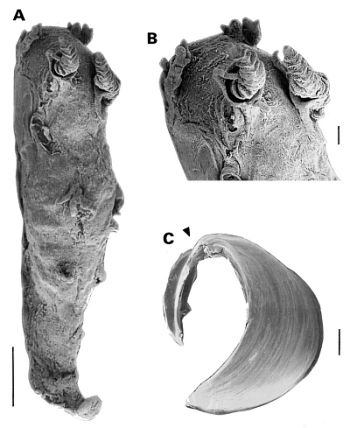
2) Dendronotus comteti
Valdes et al. 1998
I've written about this nudibranch before(Dendronotus comteti), and I am still fascinated by its biology. It's no looker, but it is the only nudibranch to be found at hydrothermal vents (and I think the nudibranch found at the greatest depth - not sure about that one). Anything found at depth and in such an extreme environment is already of special interest, but to have one species representing an entire Order (which is a lot of species) is quite impressive. I believe that there must be more species of Nudibranchs down on hydrothermal vents/cold seeps/what have you, but so far this is all we have.
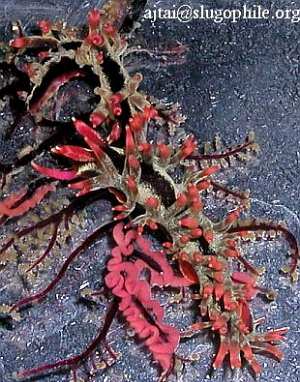
3) Hermosita hakunamatata
Photo cred Peter Ajtai
It's a nudibranch named after the Hakuna Matata. Enough said.
4) Onchidoris bilamellata
Photo cred Me. Yay!
Onchidoris bilamellata is (or was) my pet project/nudibranch species for a while. It is unique in that it can be found in huge numbers here in the Northeast (especially in Maine where I did a project on their biogeography in high school five years ago. I've typed up the entire report on a google site for all to see. Please excuse the layout/scientific methodology used; I was 14 when I started the project Check it out!!) Fascinating life history, and because they have spawning aggregations in such great numbers, it is relatively easy to find them and study their behavior.
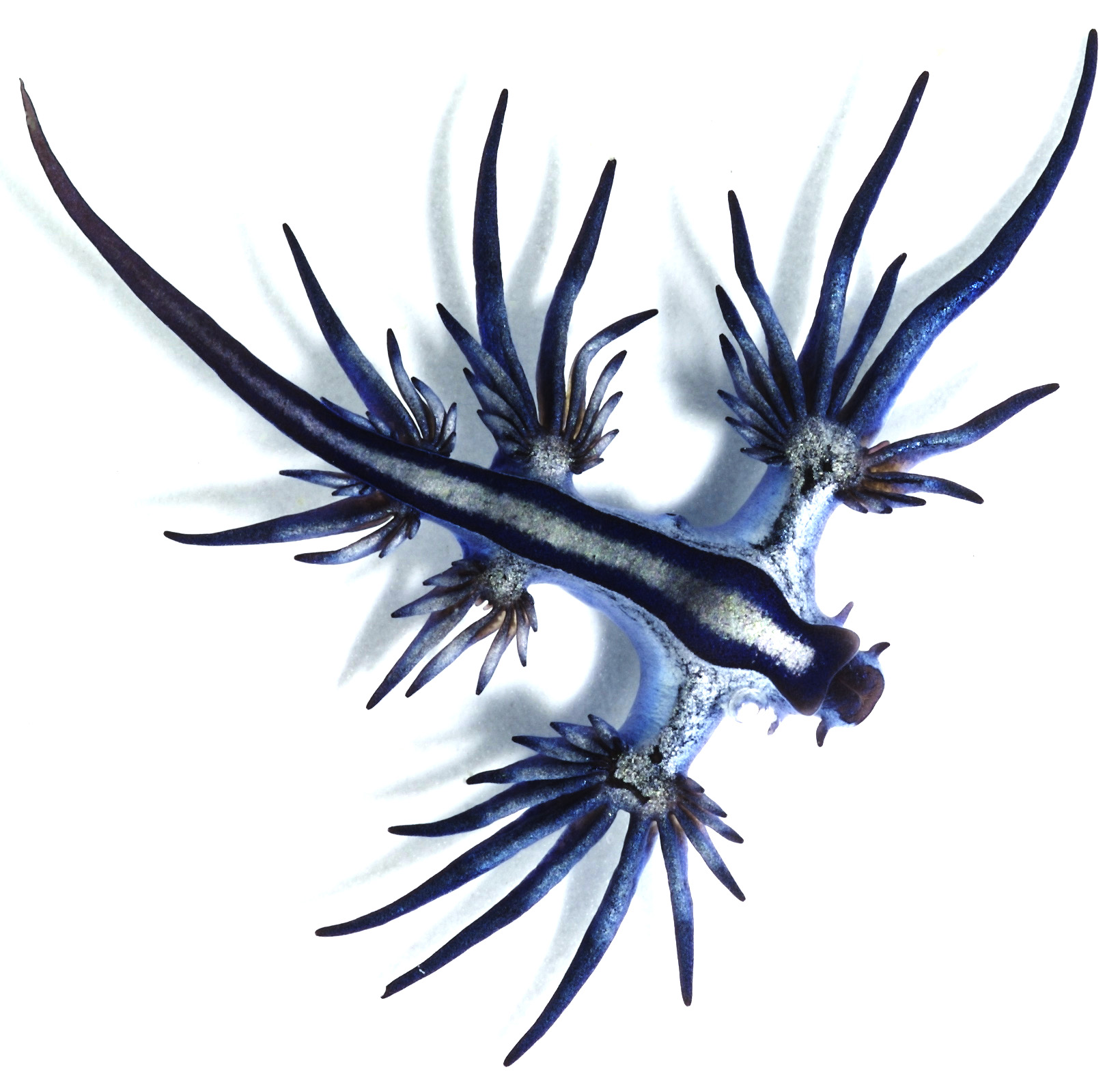
5) Glaucus atlanticus
Any list of any nudibranchs has to cover G. atlanticus. This are undoubtedly the funkiest nudibranchs out there - They adhere to the ocean surface via surface tension (you are seeing the oral side i.e. the belly in this picture - they float upside down) and munch away on Physalia physalis, or the Portuguese Man O' War, an extremely nasty hydrozoan (not a jellyfish as many people think). These nudibranchs are able to avoid being stung and even use the stinging nematocysts found within the Man O' War tentacles to their own advantage by ingesting them and forming their own nematocysts on their cerata. Gorgeous animal, definitely by top 1 nudibranch to see alive. FREEBIE - This organism always remind me of Velella velella, or the By the Wind Sailor (also a hydrozoan - and one of the best names for an invertebrate) because it too has a striking blue/white coloration. Like the Man O' War, it too is pelagic but doesn't have a sting felt to humans. Simply a gorgeous animal.
Photo cred A.F. Julien
Monday, October 15, 2012
One of the blogs I follow regularly, Deep Sea News, recently posted an article about the resurrection of a geoengineering project called Planktos, founded by businessmen Russ George, which you can read here. His company became bankrupt a few years ago after severe pressure by environmentalists and scientists halted the main project of the business, plankton seeding.
The idea was that phytoplankton, who use Iron naturally found in seawater for photosynthesis, would thrive on a massive dumping of iron fillings into the ocean and cause an algal bloom. This huge bloom would then fix the carbon dioxide in the oceans - boom, climate problem gone. He recently tested it off the coast of British Columbia, where it indeed caused a huge algal bloom (see this article and map from the Guardian). So in theory yes the artificial addition of iron worked in that an algal bloom occurred, although a bloom much larger would have to occur if a dent was to be made in carbon dioxide amounts in the ocean. So what's the problem?
Disregarding the UN's international treaty on geoengineering signed by 191 countries a few years ago, we simply do not know what the affects of such radical artificial geoengineering would be. The impact to benthic communities would be hit particularly hard as hypoxia spreads towards the bottom of the ocean as bacterial communities gorge themselves on the billions of dead phytoplankton floating down from the surface because of the rapid increase in phytoplankton population. Unused iron could alter benthic community dynamics, and it is not clear how well the carbon could be contained - in other words, whether the carbon will just cycle back into the form of carbon dioxide within a few years. At the surface, toxic waters (i.e. red tides) could spring up, harming fisheries. And finally, it is possible that this method could even worsen climate change.
I am not passing judgement yet - I will be interested to see what the affects of the bloom will be on the local fisheries and benthic communities in the next few months to years. So while I do love reading Deep Sea News, I take issue with their current article as it preemptively condemns the 'experiment'. I am in no way justifying George's action, nor am I saying that sound science lays behind it, but I would rather wait for data (even if it is likely to prove the dump was a terrible idea) to come out before it is deemed a failure/crippling blow to the environment.
Another reason I hesitate to immediately condemn the dumping is the simple lack of solutions. While I believe geoengineering to be the absolute last resort to the climate problem, there simply aren't a lot of companies out there who are in a position to help reduce greenhouse emissions as a primary goal. I think Planktos should have definitely undergone some serious smaller scale experiments are even drop geoengineering altogether - a company that is attempting to help preserve the climate and biodiversity (they have a reforestry project as well that I have not as of yet investigated) using a business model that attempts to make the environment profitable a boon. I know, I've scourged the internet for hours looking for jobs/internships in Marine Conservation - there simply aren't that many. I believe the only way we can fix the climate problem is to make being green (or blue if you prefer) profitable to the right companies while still providing the resources that people need (not want). So while I do not support geoengineering, I am saddened to see another company attempting to profit off of Conservation (in a good way!) go down.
Investigate Planktos and George for yourself. I think you will agree that while the the events that model provided by George are far from the best, conservation driven businesses can be the thing to reduce climate emissions and preserve biodiversity.
Monday, October 1, 2012
My internship may have ended, but the show of marine awesomeness must go on!
The Ikka Carbonate Columns, Ikka Fjord, Greenland - the coolest underwater geological structures ever. They form from underwater seeps of Carbonate to form a mineral called Ikaite, which form these sweet pinnacles. But they are disappearing fast, most likely as a result of ocean acidification. The pinnacles are essentially dissolving as the surrounding ocean becomes more neutral, so withing a few decades these will be gone.
Put it in full screen, HD. The action starts around 2:00 if you are lazy.
Definitely on my list of top 5 places to dive.
Sunday, August 12, 2012
Well two months have passed...I leave for Washington tomorrow bright 'n early. It has been an incredible experience to intern down here in Eleuthera seeing some amazing animals, beaches, and people. In the course of my internship I transferred one thousand juvenile Cobia from three tubs to a huge fish cage two miles offshore, gathered data on reef fish and invasive lionfish populations, logged exactly 50 dives to give me a grand total of 96 (four short of professional ranking), swam in some of the most absurdly blue water I have ever seen (better than any photo), eaten my share of delicious conch fritters and the special Eleutheran Mac 'N Cheese, spotted sharks and eagle rays, punched an over-inquisitive grouper and barracuda on the same dive, and met some amazing people.
Things I am looking forwards to when I get back home:
Air conditioning. I cannot stress this enough
Junk food (BBQ, pizza, greek food, french fries...)
getting ready for college
seeing my family!
many others...
Things I am not looking forwards to leaving:
Almost daily dives
a dorm that is about 10 feet from the ocean
the water...
amazingly friendly locals
Eleuthera in general...
It has been an incredible experience that I am glad to have taken a part in...I apologize for the infrequent blog updates, sometimes the daily ""grind" here seems not worth reporting, but looking back there is so much I could have written about. The blog will revert back to just a general blog about some of my thoughts on various marine topics...feel free to unsubscribe.
I look forwards to being back home!
Sunday, August 5, 2012
HDR of boat and Conch shell midden
mangroves growing on a conch midden
Cassiopea Upside-Down Jellyfish
Just some more random pictures I've been taking
Also, a film crew from Sweden has just arrived to film a documentary on sharks, which our shark team here will be a part of. One of the most famous names in environmental photojournalism, Mattias Klum, will be joining them - I really hope I can talk with him! Check out his website: http://www.mattiasklum.com/home
I've been busy this past week taking care of some new critters in the wetlab - Rotifers.
Courtesy UBC - those spheres by the tail are eggs.
These guys are microscopic plankton that we are attempting to culture so we can feed baby Cobia and Mahi Mahi this fall. We have approximately 200 million of these guys in our tanks right now and we have to provide an estimate count of their numbers everyday, a very tiresome task.
Cooling down a car engine, Bahamian style
Add caption
Our rotifers waiting to be put in tubs
finally we got them through security
Our Rotifers were shipped from the University of Miami so we had to go to the Rock Sound Airport to engage in some bureaucratic labyrinths before we could take them back to our lab.
Also, this is my last week here - although I am excited to be going home it will really be quite sad to leave. I'm just trying to soak it all in at this point.
Monday, July 30, 2012
New blog I created with some of my favorite photos I've ever taken - not really Eleuthera related, just thought some people might be interested.