I was fortunate enough to receive a grant to conduct
research on Kent Island, a Canadian island in New Brunswick just a few miles
south of Grand Manan this summer, and I hope to keep this blog updated with
research and general island life as long as the solar power and radio-signal
internet allow me to.
We arrived two days ago after driving four hours to the
Canadian border and over to Black’s Harbor. From there we took the Grand Manan
car ferry, and then drove to Seal Cove on Grand Manan where we loaded up our
mountain of gear including food for two months, personal gear, and research
equipment, onto one of the wide Canadian lobster boats. We arrived at KI after
an hours boat ride and soon found ourselves in a rainstorm as we sat in three
island harbor, the protected area between Kent Island and the smaller
uninhabited islands of Hay and Sheep. Since Kent Island is located in the Bay
of Fundy, the tides are some of the most extreme in the world – the dock
accessing the island lies high and dry for almost a third of each day. At this
particular time we were arriving at the island at low tide, where we had to
navigate amidst a labyrinth of rocky reefs. We could only land people in a
small tender, and so we landed with only a backpack’s worth of gear for the
night until we could retrieve the majority of our gear at a later time.
The island has several buildings, two of which were standing
in 1937 when the Island was given to Bowdoin College – a sheep barn (which now
is the kitchen, library, and a dorm) and a small shed on the dock (which now
houses a tender on the first floor and a dorm for two people on the second). I
am staying in a structure close to the dock which holds a small lab on the
first floor and three beds on the second. While we do get amenities such as
solar power, radio-signal wifi, limited cell strength, and a solar water
heater, we do get the joy (and I’m not being sarcastic) of outhouses and no
heating as well as some pretty extreme isolation save an eclectic mix of
scientists, artists, and seabirds. We have researchers and students from the
University of Guelph, Kenyon College, and of course Bowdoin. Ornithology is the
main draw to this rock, with studies from the 1940’s to present on Storm
Petrels being conducted as well as projects on Guillemots, Savannah Sparrows,
and others. Two other students and myself are doing work on the intertidal, and
four students are doing art projects ranging from science journalism to fiction
writing to composing electronic music from ambient island sounds. I will post
more about their projects as I learn about them in the weeks to come.
A quick note on island habitats – I’ve noticed three of them
so far, although there are maps describing twenty or so habitats. There is the
forest on the northern edge of the island, reaching south the main buildings.
It is in these woods that the Storm Petrels nest in burrows and let out eerie
goblin squawks at night. One area of the forest is so covered in burrows that
it is called, appropriately, The Shire. To the south lies a vast expanse of
open fields, grassland, and marsh – it is here that many other birds like the
sparrows and gulls nest. To the extreme south lies three hills, the tallest
called South Hill. These highlands are covered in raspberry bushes and seem barren
except for a few gull nests. These gulls have been laying their clutches of
three speckled eggs in their ground nests all over the island, especially near
the rocky shore. Damon Gannon, the advisor and director of the research
station, tells us that in two or three weeks the gulls will begin to attack
anyone who walks by. There is a reason hard-hat helmets are kept hanging in the
mud room of the dorm. But for now they just stare sardonically at us through
malevolent yellow eyes and shriek at passersbys.
Although one could live the two months on the island just
observing the landscape without being bored, I do have to do my project.
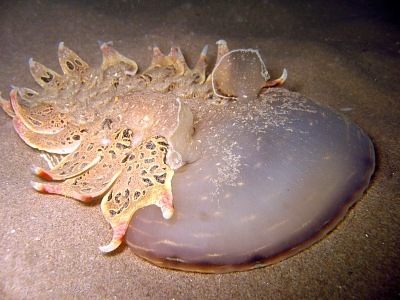
Briefly, I will be looking at the interactions between an invasive Bryozoan (Membranipora membranacea) and kelp (Laminiaria) as well as the interaction
between the bryozoan predator Onchidoris
muricata, the bryozoan, and the kelp. The bryozoan is an invasive species
native to the eastern Atlantic and Mediterranean as well as the Pacific, but
was introduced to the eastern seaboard in 1987, first noticed by divers at the
Isle of Shoals in NH/ME. The bryozoan overgrows the native kelp due to a lack
of predator interest and it is predicted to cause breakage of kelp fronds.
Since the bryozoans are composed of hundreds of individuals forming a single
colony with walls of calcium carbonate, the kelp fronds become quite rigid and
can break in the strong currents. Kelp provide a unique architecture in an
otherwise current-swept rocky shore, and can shelter the seafloor from strong
currents. This is similar to the windscreen effect of a forest compared to an open
plain. So, I am predicting that kelp that display frond breakage as a result of
bryozoan overgrowth will have a lower diversity of benthic organisms directly underneath
affected kelp forests. In addition, I will be transplanting affected and clean
kelp to a high-current area to examine the extent of current breakage and
manipulating placement of the kelp within the flow area to more or less
protected areas to find the limit of frond survival when affected. Lastly, I
will be examining if predation by the nudibranch O. muricata will effect frond breakage. We know that the nudibranch
does not eat enough of the colony to completely eliminate it, but I want to see
if by eating patches in the bryozoan colonies, the breakage rate can be
decreased by decreasing the total rigid area that is unbroken. The methods of
all of this I will go over later when I know my methods better.
Currently, I am waiting for the invasive bryozoan to settle
out of its juvenile planktonic form and grow colonies – they won’t be visible
until mid-June. So I am currently scoping out kelp beds around the island that
can be accessed via wading or snorkeling.
I will post pictures later but my battery is low, internet
is waning, and I have to get up for 6am low tide tomorrow.
Pray for fog.